
Imagine your annual salary is paid on January 1. That money has to last you all year. If you manage it carefully, you reach December with funds still in hand. But if you overspend, you run out early and have to borrow.
Earth Overshoot Day works the same way, except the “salary” is Earth’s annual budget of renewable natural resources. Overshoot Day marks the date when humanity has depleted that year’s allowance of forests, fisheries, and cropland. It also indicates when we have exceeded the capacity to absorb carbon emissions. After that day, we are living on ecological credit, taking resources from future generations.
In 2025, the global Earth Overshoot Day falls on July 24. For the rest of the year, we are consuming resources as if we had 1.7 Earths instead of just one.
Earth Overshoot Day is the date each year when humanity’s demand for ecological resources and services surpasses Earth’s capacity. This happens before Earth can regenerate those resources in that same year.
From that day until the end of the year, we are essentially in “ecological deficit”. We deplete natural capital, like forests, fish stocks, and soils. We also accumulate waste, such as CO₂ in the atmosphere. This happens faster than the planet can absorb or renew them.
In 2025, Earth Overshoot Day would fall on September 13. This would happen if the entire world consumed natural resources at the same pace as Albania. This means the date would be in September, a significant delay. The delay is 51 days later than the global date of July 24. This signals that Albanians, on average, use fewer ecological resources per person than the global mean.
At first glance, this later date might appear as an encouraging sign. It reflects Albania’s comparatively moderate ecological footprint. Several intertwined factors shape this footprint. There is a relatively lower level of industrial activity compared to highly developed economies. Dietary habits lean more towards local and seasonal produce. There is also lower per capita energy consumption. Albania’s mountainous terrain contributes significantly to its environment. Rural landscapes mean that large portions of its territory still maintain a high degree of bio-capacity. Bio-capacity is the ability of ecosystems to regenerate resources and absorb carbon emissions.
However, the September 13 date does not mean Albania is living within the planet’s means. According to earlier datasets, the ecological footprint of the average Albanian would require about 1.2 Earths to sustain if applied globally. This indicates an ecological deficit. There is a gap between what nature can provide and what society demands. However, this gap is notably smaller than in most industrialized nations.
The nuance here is important. Albania’s overshoot is later not because it is in ecological equilibrium. It is later because its demand on ecosystems is closer to sustainable limits, though still above them. The difference of nearly two months between Albania’s date and the global one suggests there are policy opportunities. There are also cultural practices worth preserving and strengthening. For instance, investment in renewable energy, particularly hydro and solar, could further reduce the nation’s carbon footprint. Similarly, encouraging local food systems and sustainable tourism could maintain low consumption rates while fostering economic resilience.
Yet, like many countries in the Western Balkans, Albania also faces challenges. These challenges could push its overshoot date earlier in the future. They include urban expansion, growing private vehicle use, and pressures from international trade patterns that import high-footprint goods. This makes long-term planning and monitoring essential.
In the broader conversation on Earth Overshoot Day, Albania stands as a reminder. It shows that a smaller ecological footprint is possible within a modern society. But it also illustrates that being “better than average” is not enough. This is true in a world where the global average itself overshoots by months. Moving from September 13 to a date outside the overshoot calendar requires more than incremental changes. It demands a deliberate shift toward regenerative economies. In such economies, human activity actively restores ecosystems instead of depleting them.
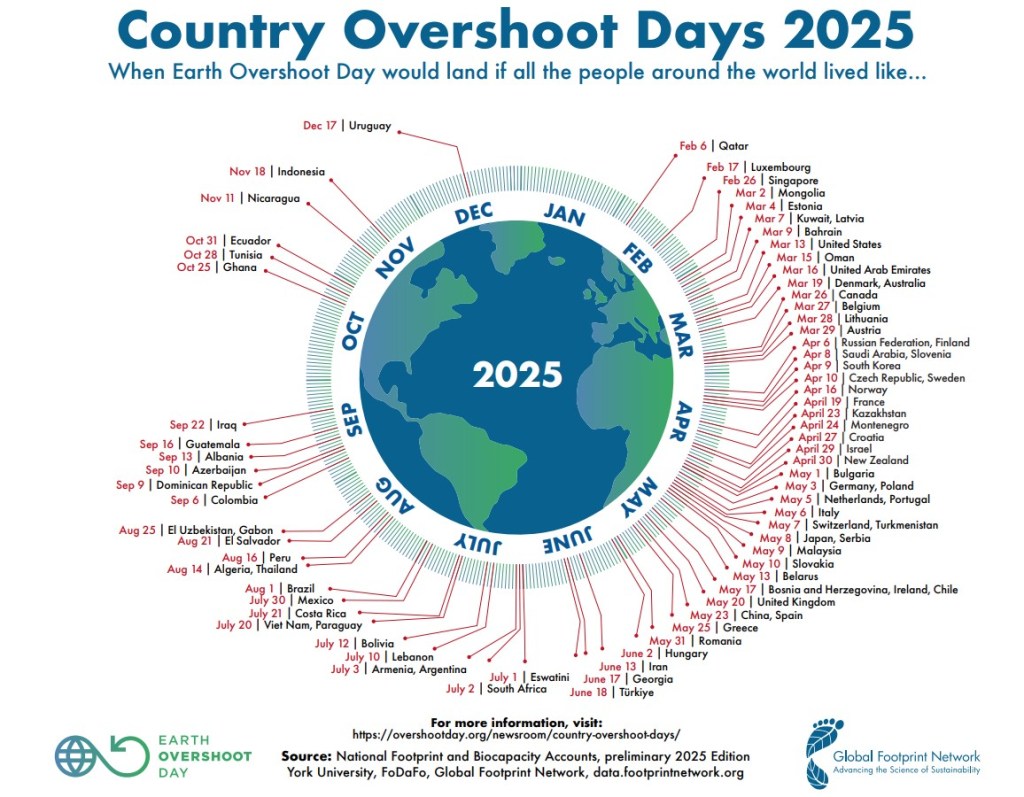
To learn more please visit Earth Overshoot Day.
References
Global Footprint Network. (2025a). Earth Overshoot Day 2025. Retrieved August 16, 2025, from https://overshoot.footprintnetwork.org/
Global Footprint Network. (2025b). Country overshoot days. Retrieved August 16, 2025, from https://overshoot.footprintnetwork.org/newsroom/country-overshoot-days/
 Ethics on Earth©
Leave a comment