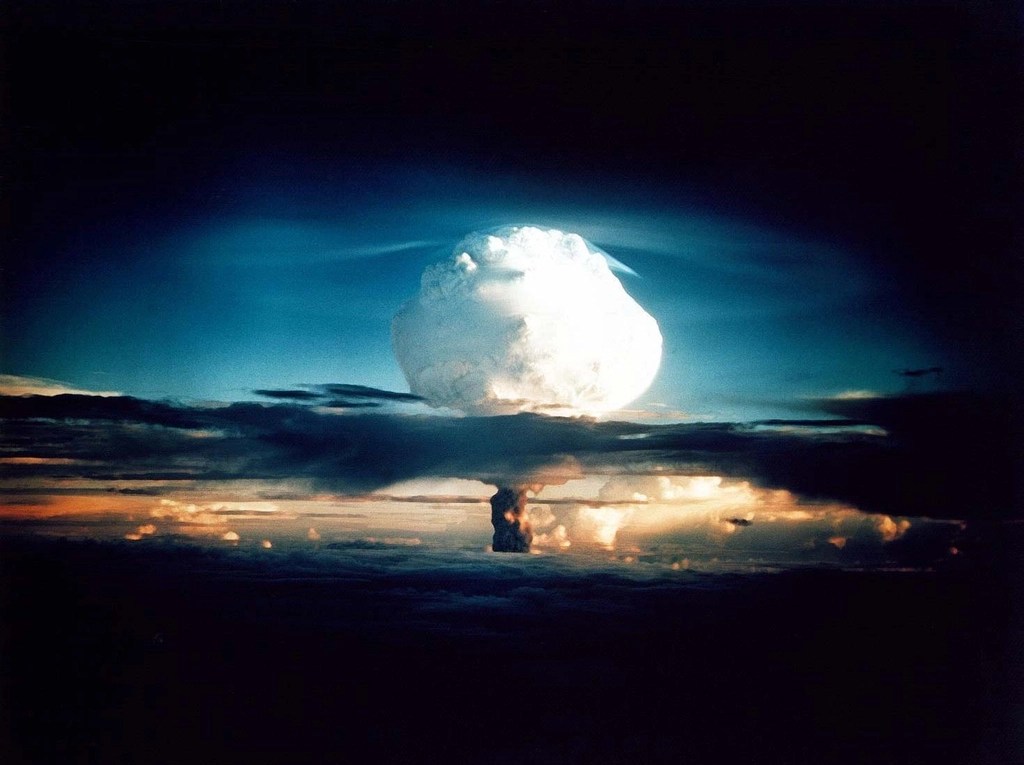
On July 16, 1945, at 5:29:45 a.m., a man-made sun rose over the Jornada del Muerto desert in New Mexico. The Trinity Test marked the first detonation of a nuclear weapon. It was an explosion of around 20 kilotons of TNT. The blast turned sand into green glass (trinitite). It also sent a shockwave felt over 100 miles away. The code name “Trinity” was chosen by J. Robert Oppenheimer, director of the Los Alamos Laboratory. He was inspired by a John Donne poem. This was an oddly poetic cover. It veiled the grim reality that humanity had split the atom to unleash unprecedented destructive force.
This was the culmination of the Manhattan Project. It was a secret wartime enterprise involving over 130,000 people across the United States, the United Kingdom, and Canada. The project was initiated in 1942 under the direction of General Leslie Groves. It brought together scientific luminaries such as Oppenheimer, Enrico Fermi, Niels Bohr, and Richard Feynman. Many of them were émigrés fleeing fascism. They worked at multiple hidden sites. They conducted uranium enrichment in Oak Ridge, Tennessee. Plutonium production took place in Hanford, Washington. Bomb design was done in Los Alamos, New Mexico.
The original motivation was fear: intelligence reports in the late 1930s suggested Nazi Germany might be developing an atomic bomb. Albert Einstein and Leó Szilárd co-signed a letter to President Roosevelt warning of this possibility, which helped trigger the U.S. effort. By the time the bomb was ready, however, Germany had surrendered (May 1945). The remaining target was Japan, whose military leaders resisted unconditional surrender despite mounting losses.
Hiroshima and Nagasaki: The Point of No Return
On August 6, 1945, the B-29 bomber Enola Gay dropped “Little Boy,” a uranium-based bomb, over the city of Hiroshima. A fireball appeared in less than a second. Its temperature exceeded the surface of the sun. This fireball obliterated much of the city. Around 70,000 people died instantly; by year’s end, the death toll exceeded 140,000 due to injuries and radiation sickness.
Three days later, on August 9, “Fat Man,” a plutonium bomb, was dropped on Nagasaki, killing an estimated 40,000 immediately and over 70,000 by same year’s end. Nagasaki was not the original target. Weather conditions diverted the mission from Kokura, a grim twist of fate known among survivors as the “luck of Kokura.”
The victims were not soldiers on a battlefield but overwhelmingly civilians, men, women, children, and the elderly. In addition to the immediate devastation, survivors (hibakusha) endured long-term effects. These effects included cancers, birth defects in descendants, social stigma, and psychological trauma. Their testimonies remain some of the most powerful moral indictments of nuclear weapons.
The Ethical Earthquake
The bombings sparked an ethical crisis that still reverberates. The official U.S. narrative stated that avoiding an invasion of Japan was necessary. Such an invasion might have cost hundreds of thousands of American lives. It could have resulted in millions of Japanese casualties. Critics, however, point to intercepted communications indicating Japan was seeking surrender, and argue that diplomatic options were not exhausted.
From an ethical perspective, several principles of just war theory are at stake:
- Proportionality: Even if ending the war quickly was the goal, could the scale of civilian deaths ever be considered proportionate?
- Discrimination: The bombs targeted entire cities, making it impossible to distinguish between combatants and non-combatants.
- Necessity: Was the atomic bombing the only available means to secure surrender? Historical evidence suggests alternatives existed.
- Precedent: Once the threshold of nuclear use was crossed, rebuilding the taboo became necessary. There was a real risk of normalizing such weapons.
Philosopher Hannah Arendt observed that technological capability had raced far ahead of moral capacity. Hans Jonas, in The Imperative of Responsibility, warned about the responsibility that comes with powerful technology. He stated that the more powerful our technology becomes, the greater our duty to anticipate its consequences. The atomic bomb was a test of whether humanity could wield apocalyptic power without destroying itself. We have not yet conclusively passed this test.
Günther Anders and the Shock of the Unimaginable
Günther Anders (1902–1992) was among the earliest responders. He gave one of the most unflinching philosophical responses. He was a German philosopher and former student of Heidegger. In his monumental work Die Antiquiertheit des Menschen (The Outdatedness of Human Beings), Anders tackled the concept called the Promethean gap. This gap is the growing chasm between our ability to create. It is also the divide between our ability to imagine, feel, and take responsibility for the consequences of our creations.
For Anders, the atomic bomb was the most extreme manifestation of this gap. He argued that our technological power had outstripped the moral and emotional equipment needed to manage it. Previous weapons had destructive power that could be imagined through direct human experience. However, people could not comprehend the atomic bomb’s destructive capacity. Its annihilation potential was qualitatively beyond understanding. This was not just “more” destruction, it was the potential to end civilization in an afternoon.
Anders was deeply disturbed by what he called our “inability to fear adequately.” The danger of nuclear weapons was not only their physical existence, but our psychological distance from their consequences. We cannot fully picture the obliteration of millions. As a result, our emotions lag behind the reality. This makes it easier to tolerate their existence.
In his correspondence with Claude Eatherly, Anders examined the paradox of responsibility in the nuclear age. Eatherly was a pilot involved in the Hiroshima mission. Eatherly was haunted by guilt. He didn’t directly drop the bomb. Despite this, he became a symbol for Anders. He showed how individuals can be morally implicated in vast technological systems. Yet, they still lack full control over them. Anders insisted that in such systems, everyone, from scientists to policymakers to ordinary citizens, carries a level of responsibility. This is because the scale of destruction implicates all humanity.
For Anders, the shock of Hiroshima and Nagasaki was not just the horror of mass death. It was the realization that humanity had become capable of self-extinction, and yet remained emotionally underprepared to prevent it. The nuclear age, he argued, demanded a radical expansion of moral imagination. This involved an ability to foresee outcomes far beyond our immediate sensory experience. We must also take responsibility for these outcomes.
The Global Ethical Challenge Today
As of today, nine countries possess nuclear weapons, with an estimated 12,500 warheads in existence. Modernization programs are underway in several nuclear states, and new risks arise from cyber threats, autonomous systems, and regional tensions. The Treaty on the Prohibition of Nuclear Weapons (TPNW) was adopted by a majority of UN Member States in 2017. It aims for total abolition. However, all nuclear-armed states have refused to join.
The humanitarian consequences of any nuclear use remain staggering. Studies suggest that a limited regional nuclear war could inject enough soot into the atmosphere. This could trigger a nuclear winter. The resulting climate effects might lead to global crop failures and famine. This transforms the ethical question from one of national security to one of planetary survival.
Epilogue: Living in the Shadow
More than seventy-five years later, the atomic bomb is both history and present reality. It is history in the sense that the mushroom clouds over Hiroshima and Nagasaki are fixed in memory. It is present reality because the weapons still exist. They are ready to be launched.
Philosopher Günther Anders spoke of a “Promethean gap.” This gap exists between what we are capable of producing and what we can emotionally and morally comprehend. Nuclear weapons epitomize this gap. They are too vast in their destructive capacity for us to truly imagine their consequences. Yet, they remain at our fingertips.
The ethical challenge is clear: Can humanity step back from the precipice it created? Can we align political will, technological capacity, and moral responsibility in a way that prevents the unthinkable?
If the atomic age began with Oppenheimer’s somber reflection from the Bhagavad Gita:
“Now I have become Death, the destroyer of worlds” –
perhaps it can only end with a new kind of declaration:
“Now we choose life, the protector of worlds.”
The Hibakusha: Voices from Ground Zero
Philosophers like Anders struggled to grasp the scale of nuclear destruction. Meanwhile, the hibakusha, survivors of Hiroshima and Nagasaki, lived it in their bodies. They carried it in their memories and daily lives. Their testimonies are not only eyewitness accounts of unprecedented suffering, but also ethical warnings for future generations. Through their words, the statistics dissolve into human faces, names, and stories.
Setsuko Thurlow, 13 years old at the time of Hiroshima, recalled:
“I found myself pinned under the rubble in total darkness. I could hear faint cries from my classmates, ‘Mother, help me,’ ‘God, help me.’ Then silence. Out of the darkness, a hand touched my arm and a voice said, ‘Don’t give up. Keep moving toward the light.’ I crawled out, but what I saw outside was a living hell, people’s skin and flesh hanging from their bones, eyes melted, hair burnt away.”
(Thurlow, S., 2017, Nobel Peace Prize Lecture, International Campaign to Abolish Nuclear Weapons.)
Sumiteru Taniguchi, 16 in Nagasaki, described his injuries after being thrown from his bicycle by the blast:
“The skin of my back hung down in tatters. I couldn’t move, I couldn’t cry. My friends were all dead or dying around me. For months, I lay face down, unable to turn over because my flesh had rotted away. I thought I would never live to see peace.”
(Taniguchi, S., testimony in Hiroshima Peace Memorial Museum archives, 2010; see also Taniguchi, 2015, Nagasaki National Peace Memorial Hall for the Atomic Bomb Victims.)
The suffering did not end when the fires burned out. Survivors faced years—often decades, of illness from radiation exposure: leukemia, organ damage, and cancers (Ishikawa & Swain, 1981). Many endured discrimination in employment and marriage because of the stigma associated with radiation sickness. Many hibakusha chose to speak publicly. They did so even when it meant reliving their trauma. They believed that their role was to bear witness so that the world would never forget.
Kiyoshi Tanimoto, a Methodist minister who survived Hiroshima, put it simply:
“The most important thing is never to let the same kind of disaster happen again, anywhere in the world. Our suffering should be the last of its kind.”
(Tanimoto, K., in Hersey, J., 1946/1989, Hiroshima, New York: Vintage International.)
These voices give the atomic bomb’s history an irreducible moral core. They remind us that the debate over necessity, deterrence, or geopolitics is never abstract. Every policy, every weapon, every military decision ultimately lands on human bodies.
References
- Anders, G. (1956/2003). The Outdatedness of Human Beings (Vol. 1). Munich: C.H. Beck.
- Jonas, H. (1984). The Imperative of Responsibility: In Search of an Ethics for the Technological Age. University of Chicago Press.
- Arendt, H. (1958). The Human Condition. University of Chicago Press.
- Malloy, S. L. (2008). Atomic Tragedy: Henry L. Stimson and the Decision to Use the Bomb Against Japan. Cornell University Press.
- Sagan, S. D., & Waltz, K. N. (2013). The Spread of Nuclear Weapons: An Enduring Debate. W.W. Norton & Company.
- Walker, J. (2012). A History of the Atomic Age. Oxford University Press.
- Hersey, J. (1946/1989). Hiroshima. New York: Vintage International.
- Hiroshima Peace Memorial Museum Archives. (2010). Testimony of Sumiteru Taniguchi.
- Ishikawa, E., & Swain, D. L. (1981). Hiroshima and Nagasaki: The Physical, Medical, and Social Effects of the Atomic Bombings. New York: Basic Books.
- Nagasaki National Peace Memorial Hall for the Atomic Bomb Victims. (2015). Testimony of Sumiteru Taniguchi.
- Thurlow, S. (2017). Nobel Peace Prize Lecture. International Campaign to Abolish Nuclear Weapons.
 Ethics on Earth©
Leave a comment