
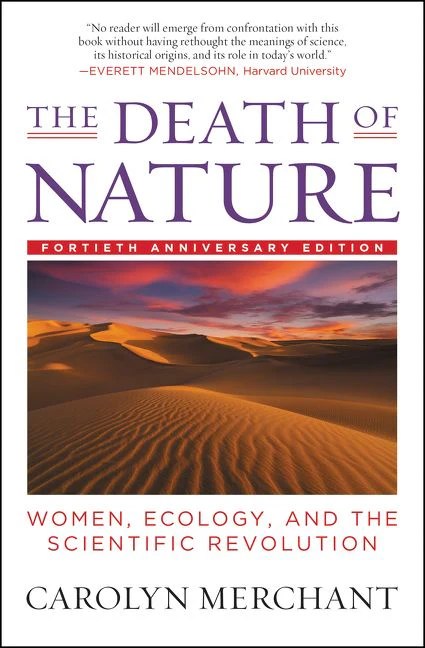
The Death of Nature, by Carolyn Merchant
Carolyn Merchant in The Death of Nature (1980) offers a profound analysis of the relationship between scientific advancements, capitalism, and gender oppression. Merchant illustrates how science and economic development have not only driven technological progress but also fostered a culture of domination over both nature and women. She emphasizes that achieving sustainable and just development requires a shift in how we perceive nature, advocating for a more inclusive and ecological approach to the world. She argues that modern Western thought, shaped by the Scientific Revolution and capitalism, has promoted a mechanistic and exploitative view of both nature and women, leading to environmental degradation and gender oppression. In contrast, she calls for a return to an ecological worldview, one that recognizes the interconnectedness of all living beings and challenges the hierarchical structures that have subordinated both women and nature.
Key Points of the Book:
- The Transformation of the Concept of Nature – In pre-industrial societies, nature was seen as a living and organic force. With the spread of scientific thinking influenced by Francis Bacon, René Descartes, and Isaac Newton, nature came to be treated as a passive object that could be studied, manipulated, and controlled.
- The Connection Between the Oppression of Women and Nature – Merchant argues that women and nature shared a common status as entities that were subjected to patriarchal and capitalist systems of control. As nature was reduced to a resource for exploitation, women’s roles were confined to reproductive and domestic functions.
- Critique of Bacon and Mechanistic Science – Francis Bacon, one of the founders of the scientific method, used violent metaphors to describe nature, portraying it as something that needed to be “discovered,” “dominated,” and “controlled.” Merchant argues that this language reflected and reinforced patriarchal attitudes toward women.
- Capitalism and Ecological Destruction – With the rise of industrialization and the free market, the balance between humans and nature was disrupted. Nature was reduced to an infinite resource for exploitation, while women were pushed out of the public and economic sphere.
- The Need for an Ecological and Feminist Perspective – Merchant advocates for a return to an ecological worldview, in which nature and women are not treated as subordinate objects, but as integral parts of an interconnected system.
1. The Shift from an Organic to a Mechanistic Worldview
Before the Scientific Revolution, nature was perceived as a living, nurturing force, often associated with the feminine principle—Mother Earth—which sustained life and required respect. Pre-modern societies, particularly in agrarian and indigenous cultures, often viewed nature through a holistic, interconnected lens, recognizing the mutual dependency between humans and their environment.
However, with the rise of mechanistic science and capitalism, nature came to be seen as an inanimate machine, a resource to be dissected, controlled, and exploited for human gain. This shift, Merchant argues, paralleled the historical subjugation of women, whose traditional knowledge of healing, agriculture, and ecological stewardship was increasingly dismissed as “irrational” or unscientific. Women, once seen as life-givers and caretakers of natural cycles, were relegated to the private sphere, just as nature was stripped of its intrinsic value and reduced to raw material for industrial progress.
2. The Link Between Ecological Destruction and Gender Oppression
Merchant’s ecofeminist perspective highlights that the domination of women and the exploitation of nature are deeply interconnected:
- The patriarchal capitalist economy prioritizes profit over sustainability, leading to environmental destruction, resource depletion, and biodiversity loss.
- Women, particularly those in rural, indigenous, and marginalized communities, are often the first and most severely affected by ecological crises such as deforestation, pollution, and climate change.
- The same ideological framework that justifies the exploitation of nature—viewing it as inert, passive, and available for human use—has historically been used to justify the marginalization of women, reducing them to reproductive and domestic roles.
For Merchant, this dual oppression must be understood as part of a broader system of domination, one that must be dismantled through an ecological and feminist reimagining of society.
3. Reclaiming an Ecological Worldview
Merchant argues that we need to return to an ecological worldview that acknowledges:
- The intrinsic value of nature – Rather than seeing nature as a machine, we must recognize it as a complex, self-regulating, and interdependent system that should be respected, not controlled.
- Women’s knowledge and agency – Traditional ecological knowledge, often held by women, must be reclaimed and integrated into environmental policies and sustainable practices.
- An ethics of care – Drawing on feminist ethics, Merchant proposes a model of relational responsibility, where humans, rather than dominating nature, act as caretakers and stewards of ecological systems.
4. Implications for Environmental Ethics and Policy
By advocating for an ecological and feminist perspective, Merchant’s work has important implications for both environmental ethics and policy-making:
- Rethinking economic models – Moving away from exploitative, growth-driven economies toward sustainable, community-based models that prioritize ecological balance and social equity.
- Integrating gender perspectives in environmental decision-making – Recognizing that women’s participation is crucial in shaping sustainable policies, especially in agriculture, conservation, and climate change mitigation.
- Shifting from anthropocentrism to eco-centrism – Developing ethics and governance systems that respect the rights of nature itself, rather than seeing it as a commodity.
Conclusion
Merchant’s call for an ecological and feminist perspective challenges the deep-seated structures of power that have historically subordinated both women and nature. By reclaiming an interconnected view of the world, she argues, we can move toward a more just and sustainable future, one that recognizes the mutual dependence of all forms of life and values cooperation over domination.
 Ethics on Earth©
Leave a comment